Back to the blog
January 20th, 2026
RTP and volatility of casino games
RTP and Volatility of Online Casino Games in Belgium: How to Determining a Game's Value
When discussing online casino games, two concepts constantly come up—and are often misunderstood: RTP (Return To Player, or "payout percentage") and volatility. In Belgium, where online gambling is governed by strict legal regulations and licensed operators such as LuckyGames Casino, these two indicators remain essential for understanding what to expect… without ever confusing "probability" with "guarantee."
Here's a clear guide to demystify it all.
❓ What exactly is RTP?
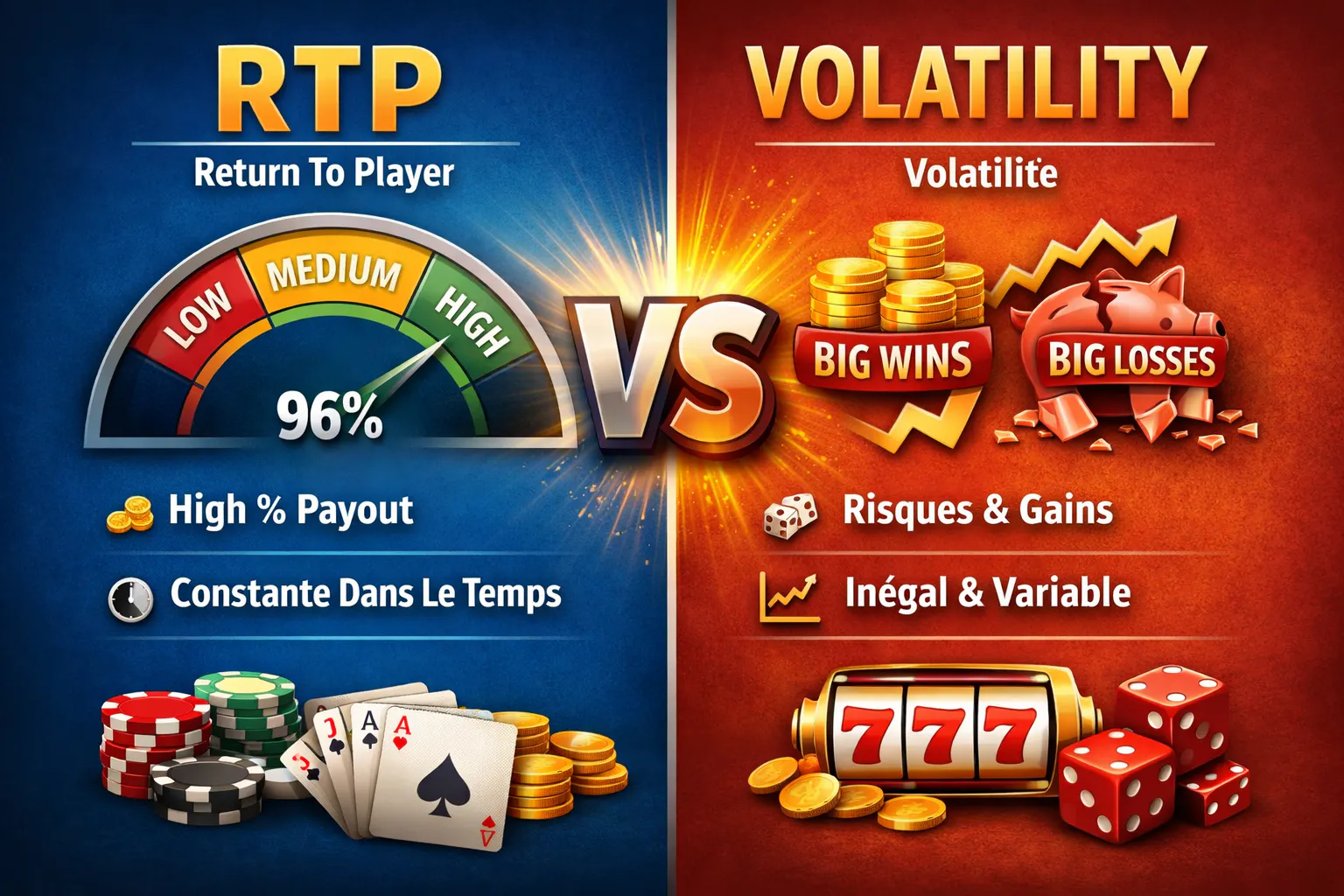
RTP (Return To Player) represents the theoretical percentage of bets that a game redistributes to players over the very long term.
- A game with an RTP of 96% means that, theoretically, over a huge volume of bets (hundreds of thousands), the game pays out €96 for every €100 wagered.
- The remaining €4 represents the house edge or the casino's advantage: this is what finances the operator, operating costs, and various taxes.
Crucial point: the RTP is not a guarantee for your session. You can win big in 20 minutes… or lose quickly, even on a game with a “good RTP.”
Theoretical RTP vs. Actual RTP
- Theoretical: calculated over a huge number of spins.
- Expected during a session: depends on variance, luck, and above all… volatility.
ℹ️ RTP of games “in Belgium”: is there a difference?
The RTP is primarily a characteristic of the game (slots, roulette, blackjack, etc.) and its configuration. In Belgium, the issue isn't simply that “Belgian RTPs are different,” but rather that:
- You play on licensed platforms such as LuckyGames Casino, therefore with regulated games, traceability, and regulatory obligations;
- Some games may exist in several versions (different RTP depending on the operator/configuration), which makes it useful to check the game's information sheet or rules.
🎯 Volatility: The True “Style” of a Game
Volatility (or variance) describes how a game distributes its payouts.
- Low volatility: more frequent wins, but often small.
- High volatility: infrequent wins, but potentially much larger.
It's a bit like the difference between:
- a regular salary (small, frequent wins),
- and a commission-based job (long dips, but a big jackpot is possible).
⭐ RTP + Volatility: How to Combine Them Intelligently
Many players only look at the RTP. In reality, the most useful approach might be one of these:
Profile 1: “I want to play long with consistent wins”
➡️ Look for:
- A decent RTP (ideally ≥ 96% if possible)
- Low to medium volatility
- A suitable stake to limit swings
Why: you reduce losing streaks.
Profile 2: “I’m aiming for a big hit, I know it might never happen”
➡️ Looking for:
- A decent RTP (again, useful)
- High volatility
- A bankroll that can handle long losing streaks
Why: You’re buying the “potential” for big multipliers, not comfort.
Profile 3: “I want to maximize my chances on table games”
➡️ Looking for:
- Favorable rules (e.g., European roulette rather than American roulette)
- Sound strategies (blackjack)
- Consistent limits
Why: On some games, the house edge is lower than on most slots, but that doesn’t eliminate the risk.
👍 Practical tips (simple, but effective)
- Read the game information: RTP is indicated, volatility is sometimes displayed (or a “low/medium/high” rating).
- Test with small stakes: observe the frequency of wins/bonuses.
- Adjust your bankroll to the volatility: the more volatile the game, the larger your reserve needs to be.
- Set a stop-loss and a stop-win: not to "beat the game," but to control your session.
- Only play with licensed operators: in Belgium, this is a basic reflex (protection, control, responsible gaming).
💥 Myths to Debunk
Online slot machines operate using a random number generator (RNG). This computer system produces completely random symbol combinations on each spin. It guarantees that each spin is independent of the previous one, with no memory of past results.
Contrary to popular belief, casinos cannot influence or predict the results generated by the RNG. Each spin is therefore unpredictable and based solely on chance.
👉 Conclusion
The RTP (Return to Player) tells you how much a game pays out on average over the long term. Volatility tells you how often it pays out: frequently and small, or rarely and large.
To choose a game that suits you, think "duo":
- RTP = theoretical return
- Volatility = frequency and risk
And above all: even with the best figures, casinos remain a game of chance to be played in moderation. The real lever for the player is management (budget, time, limits); there is no "magic formula."